




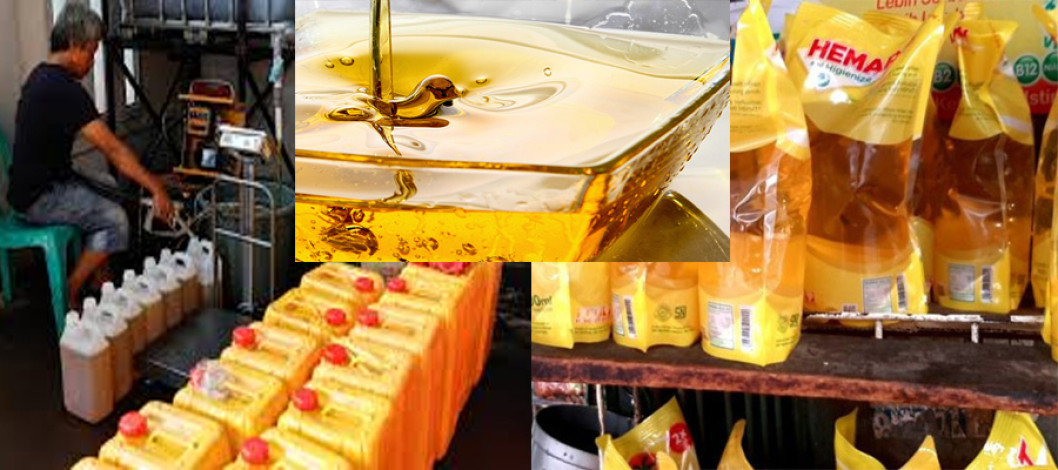
Photo: Collected
National Requirements and Consumption Patterns for Cooking Oil
Statistics on food consumption published by the Centre for Agricultural Data and Information System, Ministry of Agriculture, in 2022 indicate that consumption of palm cooking oil has risen from 16.04 kilogram (kg/capita/year in 2018 to 29.16 kg/capita/year in 2022. This translates to just under 80 grams (g) of cooking oil consumed per day. This contrasts with Food and Agriculture Organization (FAO) data on food availability, which indicates 23g/capita/day for Indonesia.1 GIMNI (Gabungan Industri Minyak Nabati Indonesia), the Indonesian Vegetable Oil Association, reported average intakes of 18 liters/capita/year or 46g/capita/day. Meanwhile, local studies have reported oil consumption to be 20.5 g/day for adult women. Thus, estimates of cooking oil consumption in Indonesia vary greatly; this is potentially because significant amounts of oil may be used in the household as a cooking medium, but a proportion of that oil is not actually consumed. Estimates of oil consumption may therefore vary depending on how it is assessed, e.g., based on expenditure, 24-hour recall, utilization, availability, etc.
Indonesia is the biggest global exporter of palm oil, where 50% of global exports are from Indonesia.4 Around 65.6% of national crude palm oil production is exported for use in food products, detergents, cosmetics, and, to a small extent, biofuel. Globally, about a third of all vegetable oils consumed is palm oil.5 Just under half of the domestically used palm oil in Indonesia is used for food; 32% of this is used by the food industry and the remainder is used by households, primarily for frying.
Structure of the Cooking Oil Processing Industry
The palm oil refining industry in Indonesia is consolidated with about 77 production companies, of which the top 5 supply 70% of domestic requirements. The 77 production companies have about 300 refineries, located across the country, with the greatest number in Central and East Java.
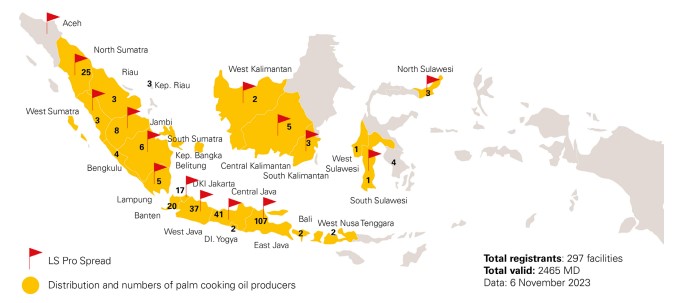
Figure 1: Distribution of BPOM (National Agency of Drug and Food Control)-Registered Palm Cooking Oil Refineries
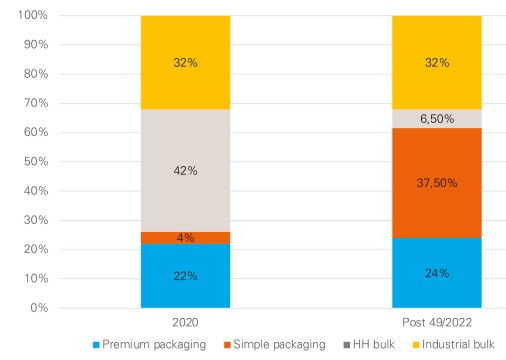
Traditionally, the majority of domestic oil for food consumption has been sold in bulk, either to food producers or to retail markets, allowing households to purchase unbranded oil in small, affordable amounts. Since 2014, however, the government has had a policy that all bulk oil intended for households should be packaged. Multiple regulations were issued to regulate packaging and other distribution and trade issues. There was limited success, however, in changing packaging, due in part to opposition from middlemen and retailers. In 2022, the government launched the “People’s Cooking Oil Programme,” which aims to provide fair and equal access to affordable cooking oil for the public. The programme includes requiring oil refineries to fulfil domestic market obligations before they can get export quotas, establishing a maximum retail price, and requiring oil to be packaged in “simple packaging” under the Minyakita brand. The programme appears to have been successful in increasing the proportion of household cooking oil that is packaged. BPOM reports that there are 157 registered producers and packagers of Minyakita in 16 provinces and 485 registered Minyakita brands for the years 2022 and 2023. As shown in Figure 2, bulk household oil has fallen from 42% to 6.5%; the proportion of oil in “simple packaging” has increased correspondingly from 4% to 37.5%.
Figure 2: Change in cooking oil packaging following launch of the People’s Cooking Oil Programme and Minyakita
Legislation, Regulations, and Standards for Cooking Oil Fortification
Fortification requirements for cooking oil are included in the Indonesian National Standard (SNI) for palm cooking oil – SNI 7709. This SNI was first issued in 2012 and was updated in 2019, and both require 45 International Units of vitamin A to be added per gram of oil. The 2019 version has been made mandatory, a conformity body has been assigned, and it has been informed to the World Trade Organization (WTO). As such, the regulatory framework for fortified cooking oil is complete and clear. There is some confusion, however, in that both the 2012 and the 2019 SNI are apparently valid. There are no global recommendations for vitamin A levels in fortified vegetable oil. Of the 35 countries with mandatory vegetable oil fortification, required levels of vitamin A range from 6-41.25 mg/kg (milligram/kilogram) as compared to Indonesia’s requirement of 13.5 mg/kg or 45 IU/g (International Unit/gram). These countries had oil consumption levels ranging from 5-37g/c/d (gram/capita/day) compared to 23 g/c/d in Indonesia. Cameroon and the Gambia have the same level of oil consumption as Indonesia; their fortification requirements are 13.2 and 35mg/kg, respectively. It has been estimated that fortified cooking oil could contribute 30-41% of the RNI (reference nutrient intake) for women in Indonesia if fortified at 40IU/g (Indonesia’s current SNI includes 45 IU/g of vitamin A).
The SNI for palm cooking oil was updated in 2019 to allow the required vitamin A content to be made up of both ‘synthetic vitamin A – retinol palmitate’ and ‘provitamin A’ or beta carotene, calculated as the vitamin A equivalent.10 This was presumably due to arguments from the oil industry and health sector that palm oil contains ‘natural’ vitamin A. Taking all the above into consideration, the amount of vitamin A in Indonesian cooking oil appears likely to be effective at improving vitamin A status. Effectiveness may be constrained however if oil consumption is lower than currently estimated, e.g., because amounts of oil actually consumed may be significantly lower than amounts of oil purchased or utilized in the household because significant proportions are used as a cooking medium rather than being consumed, and if many producers are using “pro vitamin A” rather than the more bio-available retinol palmitate.
There is confusion over the scope of the fortification requirement; several stakeholders understand or believe that it is not required to fortify “bulk oil,” which goes primarily to processed food producers.11 However, GIMNI recognizes that fortification applies to both packaged and unpackaged oil.12 MoI regulation 46/2019 has been written in a confusing way, and many stakeholders have interpreted it to say that fortification is only required for packaged oil; this has been a problem because, as of 2020, as much as 42% of oil for the domestic market was not packaged. In 2022, however, Regulation 49/2022 was issued, which associated compliance with the packaging requirement with meeting domestic market obligations and ‘rewarded’ producers with ‘multipliers’ for export of oil. A maximum retail price and generic brand “Minyakita” were also established. Since the implementation of this regulation, the proportion of oil with ‘simple packaging’ has increased from 4% to 37.5%, and the proportion of bulk oil for households has fallen from 42% to 6.5%. [See Figure 2 above] Although the requirement to fortify was not linked to the requirement to package, this significant increase in the proportion of household oil that is packaged will facilitate the enforcement of fortification requirements. It must be noted that it is not required to fortify cooking oil intended for use in food processing. In contrast, both salt and wheat flour intended for use in food processing are required to be fortified.
Sustainable and Profitable Production of Fortified Cooking Oil
In Indonesia, oil is refined in large refineries that already have all the necessary equipment for fortification. Most refineries also have all the necessary equipment for packaging oil for domestic use. GIMNI, the Indonesian Vegetable Oil Association, confirmed industry commitment to fortification and the capacity to undertake it.
There is a perception, however, that vitamin A is rapidly lost during distribution and cooking. Figure 3 below demonstrates that the vitamin A content falls by 39% between the factory and the distributor, but just over 61% of vitamin A is still retained at the household level. At Indonesian levels of cooking oil consumption, the GFDx has calculated that fortified cooking oil should provide 0.31mg/day of vitamin A, which is 62.56% of the EAR. If only 61% of vitamin A remains in the oil at the time of consumption in the home, fortified cooking oil will still provide 37.5% of the EAR. Meanwhile, a study in Bangladesh on losses of vitamin A during Asian style cooking found that losses of vitamin A were less than 50%, except in the case of deep frying, when it was 55%. The study, which was carried out in Bangladesh, concluded that fortified vitamin A would still provide daily requirements if fortified to the Bangladesh requirements of 33IU/g, lower than Indonesian requirements. See in detail.
Source: Online/GFMM






















Comment Now