




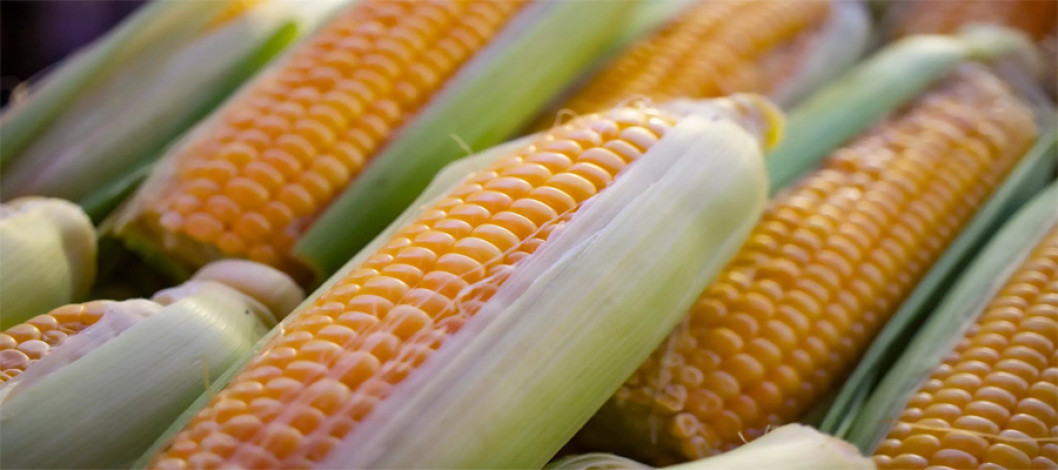
Photo: Collected
Over Thanksgiving, you likely indulged in plenty of turkey, mashed potatoes, cranberry relish, and, if you were really lucky, some perfectly steamed corn on the cob. And while surely every bit was delicious, it's that last one—the juicy cob—that offers the most thrilling feature of all: nearly perfect symmetry.
If you've never stopped to look at your corn on the cob before slathering on butter and working your way down each row, here's a fun fact for you. Almost every single ear of corn ever grown has an even number of rows.
Bryan Quoc Le, PhD, a food scientist and author of 150 Food Science Questions Answered, shared this insight with Reader's Digest in August, noting that it's "not impossible to have an odd number of rows, but most ears of corn naturally develop with an even number of kernel rows." And it's simply because the plant is programmed to grow this way. “Corn kernels are usually paired, so they form an even number of rows because of their innate developmental mechanism,” Le added.
According to Purdue University, the number of rows and the number of kernels per row are "two important yield components in corn." For hybrids commonly grown in Indiana, the ovule (potential kernel) row number ranges from about 12 to 22, but most often from 14 to 18. The number of ovules per row ranges from about 50 to 60. And while the total number of those ovules can range from about 750 to 1,000 per year, the actual (i.e., harvestable) number usually falls to about 400 to 600.
"Rows of ovules first initiate as single 'ridges' of cells that eventually differentiate into pairs of cells," Purdue explained of corn's lifecycle, noting that the row number is mainly determined by each plant's genetics and less by its environment. However, the number of ovules per row can vary. "Thus, row number on ears of corn is always even unless severe stress disrupts the developmental process."
This, however, isn't the only major fun fact about corn. As the Iowa Corn Association explained, those small "hairs" on corn are actually called silks and are "essential for pollen from the tassels to fertilize the plant. Each silk will convey pollen to one site on a developing ear of corn, making it possible for that site to develop into a kernel of corn. If it’s too hot in the summer, the silks can dry out before all the sites on a corn cob are fertilized. As a result, there will be gaps on that ear of corn where no kernels developed because they weren’t fertilized."
So, know that a whole lot of hard work from Mother Nature and farmers went into getting this corn to you. And, if you do get an ear with an odd number, know you've got something truly special on your hands. Don't worry. It's just as delicious. See details.
Source: Online/GFMM






















Comment Now