


The poultry industry in Bangladesh is no longer just a promising industry, it has become one of the most important agro-based food industries in the country. The contribution of this industry in meeting the animal protein needs of about 17-18 crore people is now undeniable. At the same time, the industry is also thinking about the possibility of entering the global market and exporting poultry products. This is undoubtedly a matter of pride for us. But before knocking on the door of the global market, we need to ask ourselves two basic questions:
1. How sure are we
about the food quality of the poultry products we produce?
2. Can we really say with certainty that every egg and every poultry meat produced in Bangladesh is 100 percent safe food?
Before answering
these two questions, we need to understand one thing clearly:
Safe food and traceability are not the same thing. Traceability does not mean safe food. One thing needs to be specifically clarified here. Traceability alone does not guarantee safe food. But without traceability, it is very difficult to verify and prove the claim of safe food.
When we look at the
market system in Bangladesh, the picture we see is that information about the
producer, band, batch or production date can be found in a limited amount of
packaged eggs and meat in supermarkets. But millions of eggs and a huge amount
of live chickens are being sold every day in thousands of general shops,
markets and raw markets in the country.
As a consumer, you
buy eggs from a shop. Can the seller say with certainty:
● Which farm did
this egg come from?
● Which farm?
● Which batch or
lot?
● When was it
produced?
● How many routes did it take to reach this market?
Let's ask a simpler
question:
Is this egg from Kazi Farms or Paragon or RRP or some other farm? In the current conventional market, there is no way to give a reliable answer to this question.
The same question
applies to live chickens. Can a consumer know whether a live chicken sold in
the raw market is from CP or Nourish, Nahar Farm, or from another farm?
Usually, they
cannot.
This is where traceability comes in.
What is
traceability?
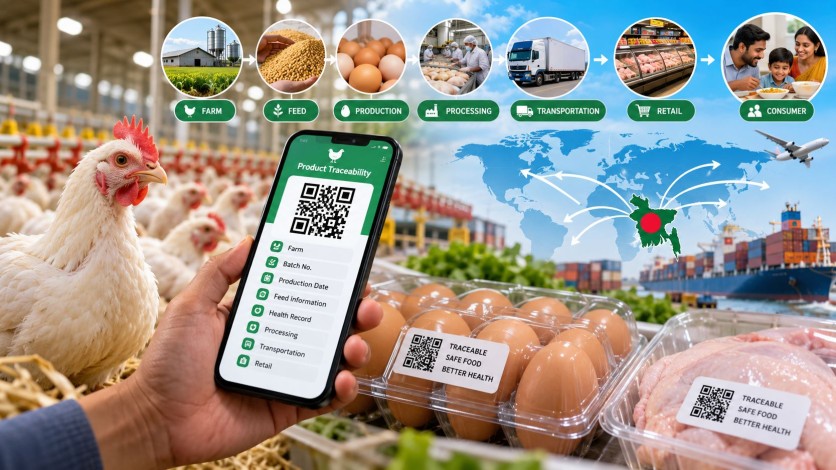
Traceability is a system through which a food product can be identified and followed from its origin to the consumer's table. That is, if a question arises about a product, we need to be able to say where it was produced, who produced it, which batch it was from, how it was transported, and through which supply chain it reached the consumer.
Its importance is
not limited to knowing only information.
If a problem occurs
in a food, traceability helps us:
● To identify the
source of the problem
● To identify the
affected batch or lot
● To quickly
withdraw the product from the market
● To know where
other products from the same source have gone and
● To prevent the same problem in the future.
In other words,
traceability is a very important chapter in safe food management. It can also
be called the backbone of safe food management.
The question is
“Are Bangladeshi poultry products safe?”
The next question to this question is, can we prove it?
Let’s say, a safety
problem was found in an egg or chicken brought to your home from the market.
1. Can we find out
which farm produced that egg or chicken?
2. Can we quickly
identify where in the country the products produced from the same farm or batch
were supplied?
3. Or, will it be possible to withdraw them from the market?
If the answer is not completely “yes”, then an important part of our safe food management is still incomplete.
Traceability does
not mean safe food. Just because a product is traceable does not guarantee that
it is safe. To ensure safe food, it is necessary to:
● Safe animal/animal
feed
● Proper farm
management
● Biosecurity
● Animal drug
control
● Residue
monitoring (testing pesticide or drug residues in food)
●
Hygiene/cleanliness
● Processing
standards
● Cold chain
● Proper quality control
But traceability is essential to verify, prove the effectiveness of this entire system and take quick action if there is a problem.
 Author: Mr. Kazi Ekhlasul Haque, Managing Director, Chicks and Feeds Limited, Dhaka, Bangladesh.
What is needed now?
If Bangladesh's poultry products really want to go to the global market, then it is necessary to start working nationally with information from a farm to the table now.
1. What the poultry industry needs to do:
A uniform digital
record and unique identification system can be created for each farm, batch,
food, medicine, production, transportation and sale. The system should be
simple, low-cost and mobile phone-based for small and medium farms.
2. Government action:
It is necessary to
formulate a national traceability standard, labeling and record keeping
framework.
In addition,
residue monitoring (testing for pesticide or drug residues in food),
hygiene/cleanliness
Processing
standards,
Cold chain,
biosecurity and
Proper quality control should be strengthened.
3. Connecting every stage of the supply chain.
From farms to suppliers, pharmaceutical services, wholesalers and retailers, everyone should be brought under the same traceability framework.
4. Consumer participation.
Consumers should be given the right to a system where the source of the product and necessary information can be known by scanning the QR code or batch number.
5. The most important initiative of the National Poultry Traceability Platform through BPICC could be a central digital platform. Where the necessary information from production to market will be stored and in case of any food problem or food safety threat, it will be possible to know all the information quickly.
170 million people
to 170 countries:
Bangladesh's
poultry industry is providing food to 170-18 million people today. The goal of
the future may be to reach Bangladesh's poultry products to the markets of 170
countries of the world.
But for the export market, it is not the quantity of production, but safe food.
The global market
wants:
● Food safety
● Quality
● Consistency
● Traceability
● Consumer
confidence
So our goal should not be just "more production", but our goal should be safe food, balanced nutrition and traceability. We do not want to just tell the potential buyer countries of poultry products "Our food is safe."
We want to create a
system through which we can say,
“Yes, this food is
safe and we can prove where it came from, how it was produced and how it
reached your table.”
This could be a big
challenge and opportunity for the Bangladeshi poultry industry.
Every food from the
farm to your table must be traceable.
At the stage where
the Bangladeshi poultry industry has reached now, traceability is not a luxury.
It is a prerequisite for our safe food, consumer confidence and the
infrastructure for exporting Bangladeshi poultry products to the global market.
---












Comment Now