



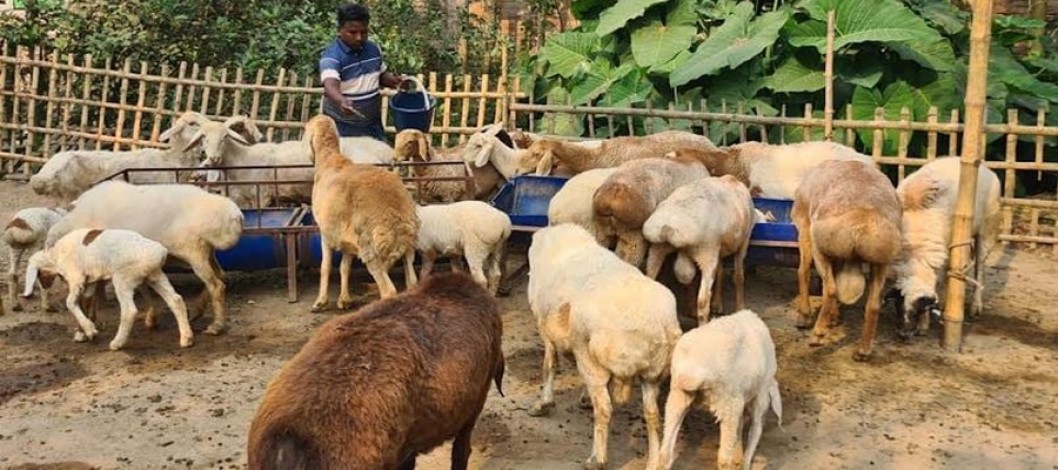
Photo: Collected
Rearing dumba, a desert sheep breed, commercially has brought financial success to farmers in different parts of Bangladesh. Rabiul Islam, youth of Nilphamari Sadar upazila, has attracted considerable attention by successfully raising the breed.
Rabiul, a farmer's son from Katharipara village in Botlagari union of Saidpur, started his venture with just two dumba about three and a half years ago. His herd has now grown to 65, with an estimated market value of nearly Taka one crore.
After passing his Secondary School Certificate (SSC) examination, Rabiul had planned to go abroad in search of work. However, various obstacles prevented him from pursuing the plan. Looking for an alternative livelihood, he decided to try something different and began rearing dumba.
His interest developed after watching videos about the animals on Facebook and YouTube. Later, following advice from his elder brother living abroad, he took steps to collect Turkish-breed dumba. After successfully raising two animals on a trial basis, Rabiul acquired another six. He spent around Taka12 lakh to purchase the eight animals.
“Within six months, the dumba began producing offspring. Their numbers gradually increased through breeding, and after three and a half years, I now have 65 dumba in my farm,” Rabiul told BSS.
The animals are mainly fed green grass, khoil and bran. Five workers are employed at the farm to look after them. According to Rabiul, an adult dumba can weigh between 50 and 100 kilograms, while the price of an animal ranges from Taka1.5 lakh to Taka 2.5 lakh, depending on its age, weight and size.
“Green grass is their preferred food. Including grass, khoil and bran, the daily feeding cost for each dumba is around Taka 20 to Taka 30. With timely feeding, proper care and preventive vaccination, they grow quickly,” he said.
Each animal can give birth twice a year, producing one or two offspring each time. At three months of age, a dumba can weigh between 35 and 40 kilograms, and a calf of that age can fetch around Taka 1 lakh in the market. Rabiul said that he was once deeply concerned about finding employment, but the farm has now kept him busy while creating jobs for five people from his locality.
One of the farm workers, Kalu Mia, said the farm has helped support five families.
“Because of Rabiul bhai's dumba farm, five families like mine are able to earn a living. If the farm expands further, more people will get employment,” he said.
Rabiul said many people visit the farm every day, and a large number of visitors are becoming interested in rearing dumba themselves. He believes the expansion of the sector could create employment opportunities for many people. Demand for dumba increases particularly around Eid-ul-Azha, when buyers from different parts of the country contact him. Many customers book animals in advance ahead of the festival.
“We are already receiving a strong response from customers for the next Eid-ul-Azha. People are calling from across the country, and many want to see the animals online. There is also considerable demand during the rest of the year, so I am not worried about selling them,” Rabiul said.
Saidpur Upazila Livestock Officer Md Abu Kayes Bin Aziz told BSS that Rabiul has achieved success in dumba rearing and that his success is encouraging others to take up the practice.
“We are providing him with technical assistance for dumba rearing, along with government-supplied vaccines against various diseases,” he said.
The livestock officer said dumba rearing can be profitable because the animals are relatively resistant to diseases and easy to raise. They reproduce twice a year, producing one or two offspring each time, and grow rapidly with proper care. As dumba farming is still not widespread in Bangladesh, their meat commands a relatively good price in the local market. A dumba weighing around 100 kilograms can sell for more than Tk 2.5 lakh, he added.
Source: Online/GFMM


















Comment Now