




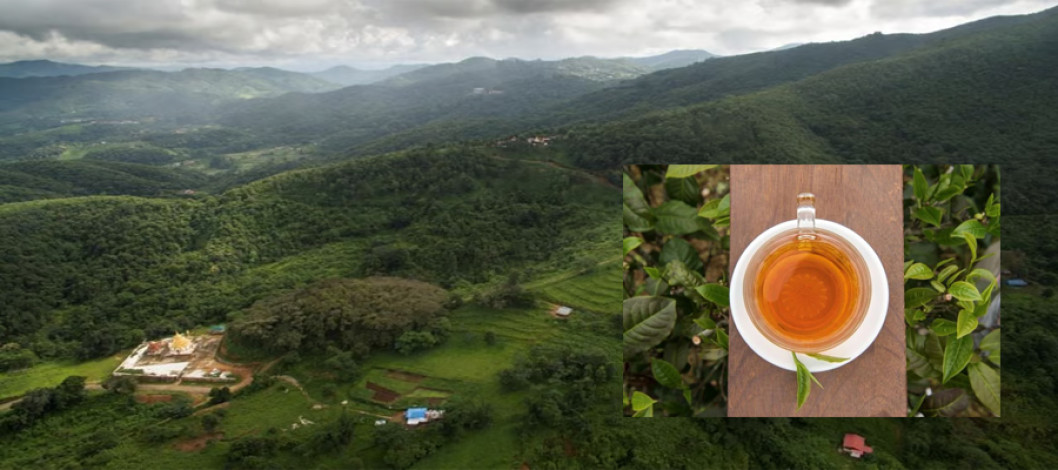
The lush and hilly region of Mogok, where Mogok tea is grown, is a sub-tropical region that differs from much of the rest of Myanmar (which is tropical jungle) and reaches an altitude of around 3300 feet, producing fine aromatic artisan teas. Photo: Collected
In the wake of a devastating earthquake in March and a recent history involving a military coup, human rights abuses, restriction of liberties, and armed conflict, tea offers a ray of light that cuts into the darkness blanketing Myanmar.
Although surrounded by countries with well-developed tea industries like India, China, Thailand, and Bangladesh, the nation that was called Burma until 1989 and is often still referred to by that name among locals, has not been similarly developed in tea.
Burma is said to mean “Land of Brahma,” who is the creator in the ancient Hindu pantheon of Gods and Goddesses that predates the current Burmese culture. It was this sense of creating something new that motivated Phyu Thwe, a British Citizen born and brought up in Burma, to build on the growth of wild tea plants growing on her family’s land in the village of Mogok, located around 200 km northeast of Mandalay (Myanmar’s second largest city).
Thwe’s path to becoming the proprietor of a social enterprise in tea has been a circuitous journey full of challenges. Indeed, Myanmar is not known for producing high-quality teas—and neither was the region of Mogok. Rather, for more than a millennium, what made it special was the presence of precious stones embedded in the earth, which were mined both formally and informally, with villagers simply digging for buried treasure. The prospect of riches brought people to the village from various places, transforming its parochial roots into a multicultural town.
The presence of rubies, sapphires, jade, spinals, and even diamonds has been recorded since ancient times. “People would come [to Mogok] hoping to get lucky,” says Thwe. It created a ‘gem rush’ since Burma became independent from British rule in 1948.
That said, according to Thwe, “From the 1990s onwards, mining permits became increasingly difficult for locals to obtain, as the government began granting rights to the highest bidders, typically large companies. Since then, many residents have been left to rely on whatever leftovers the bigger companies provided, or simply on luck.”
Over time, Thwe says, excessive mining and the natural depletion of resources have made mining not only more difficult but also unsafe. Along with the advent of technology, internet access, and better infrastructure in the country, many of the younger generation left Mogok to pursue opportunities in the cities and abroad, leaving the town’s elders and remaining locals with virtually no other industry on which to depend than what lay beneath the land.
Nobody, it seems, except Thwe had any sense that another kind of treasure would emerge from the ground just as jewels had once been plentiful deep in the soil.
Source: Online/GFMM



















Comment Now