



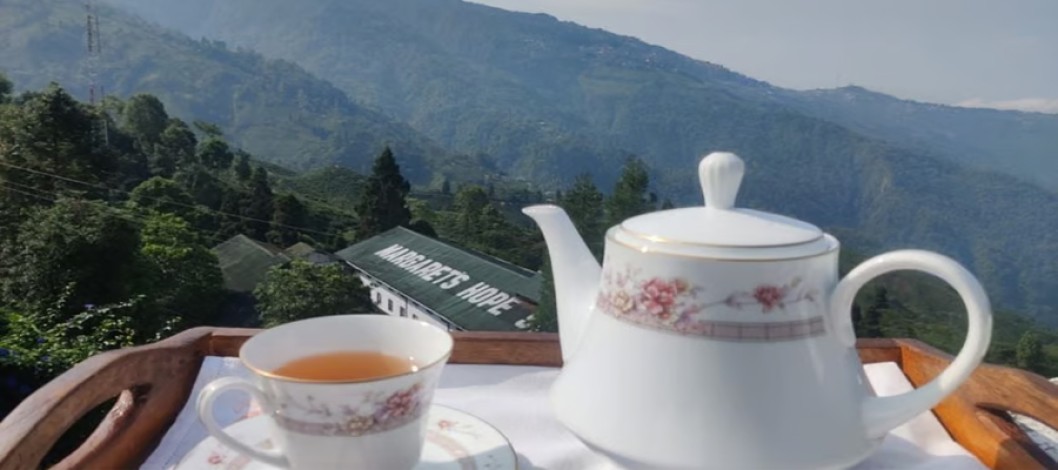
With emerald hills sloping away in gentle curves, their contours softened by rolling mist that floats through the air like a quiet breath, Margaret’s Hope Tea Estate has become synonymous with Darjeeling over the 160 years since its founding in 1864.
A visit to the estate reveals layers of foliage blurring into one another as the sun peaks through clouds flashing on verdant tea bushes, dark pine, and moss-covered earth. The air feels cool and damp, carrying the scent of tea leaves and the feeling that thunder could clap at any time. The cottony mist thins and thickens as the light shifts, turning the hills into a living landscape – at times vivid and clear, sometimes hazy and dreamlike – but always peaceful yet full of life.
Its storied history evokes somber longing for a past that has simply just passed. The estate’s owner, The Goodricke Group of India (a subsidiary of the British company, Camelia PLC, the largest tea company in the world), is trying to write a new chapter in the story of Margaret’s Hope Estate. After more than a century and a half of doing things the same way, faced with challenges like labor shortages and rising costs, they are trying some innovations.
Goodricke is the second most prolific producer of tea across Darjeeling, Dooars/Terai, and Assam regions. But at least four of their five gardens in Darjeeling are their most prestigious holdings, where some of the finest teas in the world are made. Margaret’s Hope, Castleton, and Badamtam - all Goodricke estates are considered the best in the region, depending on which "expert" one may consult.
That they are experimenting with such a prestige garden demonstrates how serious the company is about responding to the times.
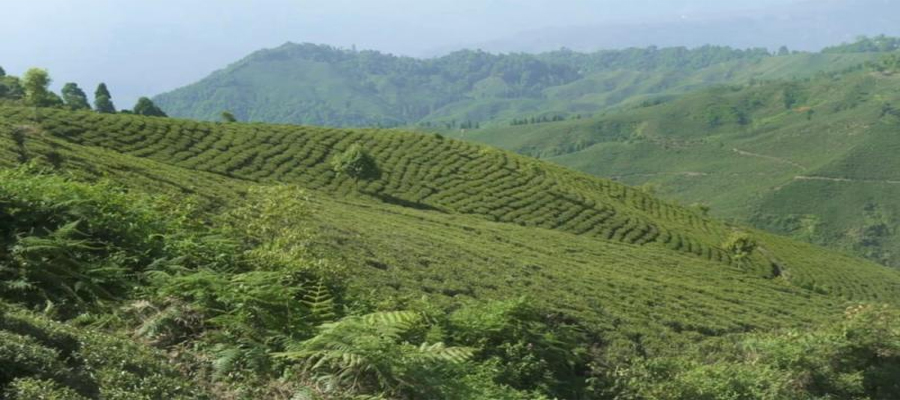 Inside Margaret’s Hope Tea Garden. Photo: Collected
A Brief History of Margaret's Hope Tea Garden
It was first known as Bara Ringtong by the garden manager and was most likely first owned directly by the British East India Company, under which Dr. Archibald Cambell worked – first as superintendent of the sanitorium that the British had built in Darjeeling to help ailing and homesick British servicemen and bureaucrats recover from their ailments. However, he began experimenting with cultivating tea in the region. He found that the Chinese variety, Camelia sinensis var. sinensis, thrived under the cool, misty conditions of the hills, whereas the local variety, Camelia sinensis var. assamica, did better in the adjacent plains regions of Dooars-Terai and, of course, Assam, where they were first cultivated.
When the British Empire nationalized the company, they gave out 30-year leases to people who were de facto owners, sometimes also referred to as just managers.
One such owner/manager, J.G.D. Cruickshank, who held and managed the estate between 1900 and 1930, renamed the estate to Margaret’s Hope.
The Cruikshank family lived in London and as the story goes, he brought his wife and youngest daughter Margaret to the garden. She instantly fell in love with its breathtaking green slopes, the two rivers that run through it, and the lake that is home to the Himalayan salamander (the only place where the species can be found).
While she had to return to England when the vacation was over, it is said that her last words to her father upon departing Darjeeling were, “I hope to come back again to the garden.” Unfortunately, this was not to be, for Margaret did not survive the four-month seaborne journey back to England. She is said to have succumbed to a tropical disease, but how much of her ailment was affected by longing for the garden can only be imagined.
Her father became grief-stricken upon hearing the news, and locals say he wandered the garden as though haunted by the memories of that vacation. During one of these rambles, he is said to have had a vision of young Margaret sitting at her favorite spot in the tea garden. Believing it to be a message that her eternal soul still longed to return, he changed the name of the garden from Bara Ringtong to Margaret’s Hope in 1927 in her remembrance.
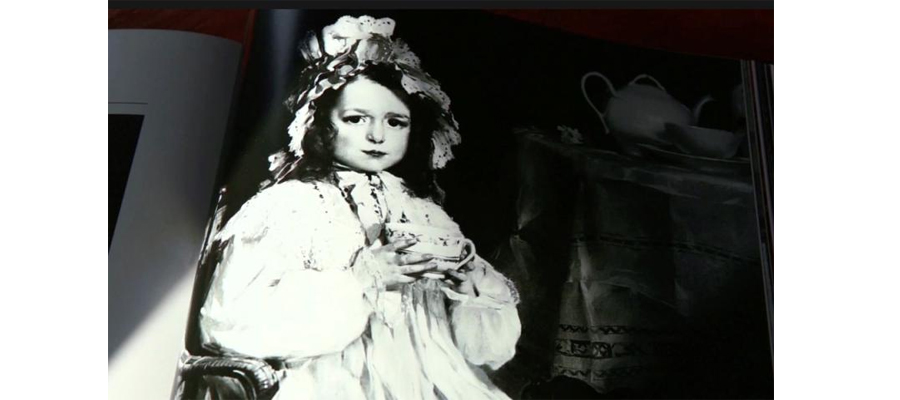 Artist’s rendition of Margaret Cruikshank. Photo: Collected
Stories abound, even today, of sightings of a young white girl roaming around the garden, which many interpret as Margaret’s spirit visiting her garden.
Margaret's Hope Tea
Whether one believes the stories of Margaret’s periodic returns, what is not in doubt is that the tea cultivated at the garden, spanning around 1500 acres, stands among the finest teas in the world. This is especially true of its First Flush, which is light golden in color, powerfully aromatic with a floral bouquet and fruity nose. With orchard scents, it carries fruity notes, grape, melon, and honeysuckle. It is silky smooth in texture with a crisp light body, and hint of muscatel flavor.
While mostly China bush grows on the estate, newer AV 2 clone has been planted and found to do extremely well, especially in making specialty teas.
Challenges Faced by Goodricke in Darjeeling
Tea gardens the world over are generally being affected by climate change. It has resulted in sporadic weather conditions. Indeed, the cloudburst and flash flooding causing massive landslides, downing of bridges, washing away entire cliffsides along with roads, as well as 42 deaths, that occurred in October 2025 is demonstrative of the risks of posed by such extreme and unpredictable weather. What surprised planters the most is that October is not known for rain – but more rain fell than was recorded in most people’s lifetimes.
With increasingly harsh conditions on the rise, punishing heat in the summer, and sporadic rain causing landslides and injury, absenteeism, understandably, is on the rise at most Darjeeling gardens.
Moreover, the younger generation who have been educated by their parents long for careers in urban centers that make use of the knowledge they’ve attained at colleges and universities. Hence, the availability of labor in the next generation when current workers retire will be scarce.
Estate owners either need to entice workers to forgo life in the city by increasing wages and improving conditions – or bring in labor from other markets. That said, it’s not easy for someone used to life in the plains to work in the hills. Generations of living in hilly regions have made the Gurkha workers of Nepali origin in Darjeeling physically accustomed to working there. Studies have shown that highlanders have higher lung capacity, broader chest cavities, and lithe bodies and sturdy legs that make it easier to amble up slopes. Whether the adaptations are Darwinian or otherwise, they have been documented.
Finding a Solution
The circumstances have prompted companies to consider forms of mechanized plucking (which doesn’t necessarily mean automated because the level of leaf ready to be plucked is referred to as the leaf table is not even in the hills as it is on flatlands, requiring people to operate the plucking machines).
For the first time in its history, Goodricke experimented with mechanical plucking – this too at one of its two most prized gardens, Margaret’s Hope.
Of course, they didn’t risk their first and second flush pluckings (spring and summer harvests), which account for some 80% of Darjeeling tea exports and garner the highest prices. These harvests are the ‘bread and butter’ of the Darjeeling tea industry.
Monsoon flush, however, which is of lower quality since the tea grows too quickly in the rains to develop the unique and complex flavor compounds formed in earlier harvests, is typically used in blends and sold domestically at lower prices. So, Goodricke decided they could risk some loss in this harvest to test out their efforts.
Plucking by hand during monsoon is quite dangerous for workers as the change of slipping or getting caught in a landslide is higher during this season than any other. So, most workers would want to avoid hand-plucking at this time anyway. See details.
You can learn about South Asia's
largest exhibition on this topic through this link: https://teacoffeebd.com/
Source: Online/GFMM





















Comment Now