




Photo: Collected
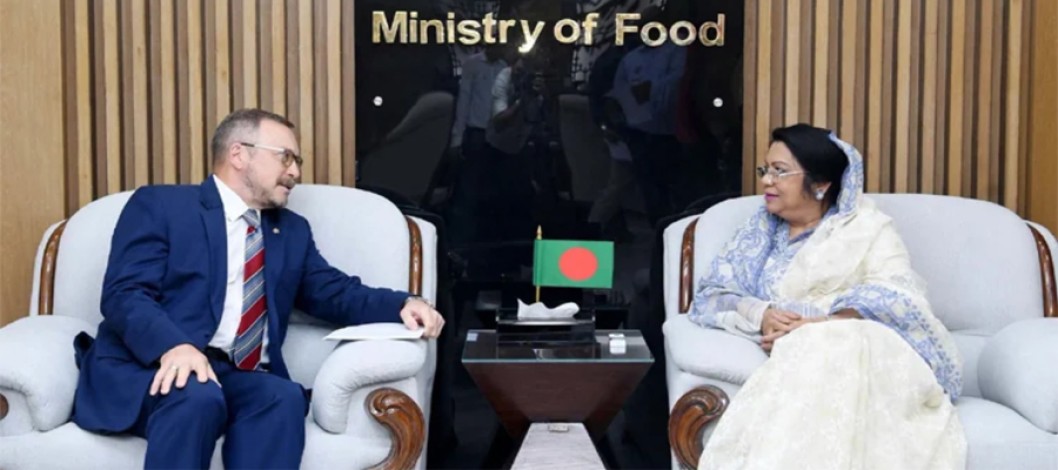
Bangladesh’s Food Minister Afroza Khanam has proposed building a wheat silo with Russian financing on unused land at Payra Sea Port in Patuakhali, with capacity phased from 2 lakh to 5 lakh metric tonnes. The proposal came during a courtesy call by Russian Ambassador Alexander Khozin in Dhaka, who separately suggested exporting wheat to Bangladesh on a government-to-government basis.
The move, if it proceeds, would tie together three things the Bay of Bengal trade has struggled to align: bulk grain import capacity, port-adjacent storage, and a financing structure that does not depend on Bangladesh’s foreign exchange reserves.
The Proposal, Precisely
The Russian side put forward two ideas. First, a G2G wheat export arrangement, under which Russia would supply wheat directly to the Bangladesh government. Second, construction of a wheat silo at Maheshkhali in Cox’s Bazar with Russian financing.
The Food Minister responded that suitable land for infrastructure of that scale is scarce in the Cox’s Bazar area, and proposed Payra Sea Port as an alternative. She noted that the necessary port infrastructure and communication links already exist at Payra, making it a more practical site for a large-capacity silo.
The operational plan she outlined: start at 2 lakh metric tonnes and scale in phases to 5 lakh tonnes. Stored wheat would be available for sale to private wheat importers in the domestic market, and for government procurement when needed. She invited the Russian ambassador to visit Payra to assess site suitability, infrastructure and implementation.
The G2G import proposal is under review, with a decision to be communicated later.
Why Payra Makes More Sense Than Maheshkhali
The site logic is worth unpacking, because it captures a recurring problem in South Asian port development — matching cargo infrastructure to actual land availability.
Maheshkhali has been positioned as a future industrial and energy hub, but Cox’s Bazar district is land-constrained, and large-footprint agri-storage projects compete with tourism, energy and existing settlements for space. Payra, by contrast, was developed as a deep-sea port with dedicated hinterland, and its rail and road connectivity toward Narayanganj and Baghabari in Sirajganj — two of Bangladesh’s principal grain distribution nodes — makes it a natural discharge point for imported wheat.
That connectivity point is the real commercial argument. A silo is only as useful as the evacuation chain behind it. Storage at a port with weak onward links simply shifts congestion from the anchorage to the warehouse.
The Shipping Read-Through
Bangladesh depends on imports for the majority of its wheat requirement, and Russia has become a significant supplier alongside Canada, Ukraine and Australia. A G2G arrangement would formalise that flow and give Russian exporters a predictable volume channel.
For dry bulk markets, three effects follow:
* Longer-haul grain voyages. Black Sea and Baltic wheat moving to Chattogram and Payra absorbs Supramax and Panamax tonnage on longer voyages than intra-regional alternatives, supporting freight on the India-Bangladesh-Black Sea triangle.
* Discharge efficiency. Bangladeshi ports have historically faced berth congestion and lighterage constraints, with larger vessels discharging mid-stream or at anchorage. Dedicated silo capacity at Payra could raise discharge rates and reduce demurrage — a direct saving for charterers and importers.
* Port competition. Volume shifting to Payra would come partly at the expense of Chattogram and Mongla, accelerating the redistribution of Bangladeshi cargo across three gateways.
For shipowners already serving the Bay of Bengal, the more relevant question is whether Payra can handle the parcel sizes that make Russian-origin wheat economic. Silo capacity of 2–5 lakh tonnes implies regular Panamax or Supramax callings, which in turn depends on channel depth, draft and berth availability.
Storage Economics and the Finance Angle
South Asia’s grain storage deficit is a structural weakness, and it manifests in a specific way: governments import at whatever price the market offers during a shortage, because there is nowhere to hold strategic cover bought cheaply earlier. Silos convert a procurement problem into an infrastructure problem.
The financing structure proposed here — Russian-funded construction — is a form of supplier-linked infrastructure credit. It carries advantages and dependencies:
* Advantages. It removes the need for upfront foreign exchange outlay by a government under balance-of-payments pressure, and ties the asset to a committed supply relationship.
* Dependencies. It embeds a commercial relationship into hard infrastructure, and repayment terms may be structured through future grain purchases rather than cash. Those structures require careful scrutiny on pricing benchmarks and currency risk.
* The wider opportunity. Port-adjacent silos, conveyor systems, weighbridges and rail sidings are bankable infrastructure assets with long useful lives. For development finance institutions and export credit agencies, they sit comfortably in the agri-logistics category.
For commodity traders and importers, a functioning silo system at Payra would also create a new set of working capital structures — warehouse receipts, collateral-managed inventory and storage-linked trade finance, all of which are underdeveloped in Bangladesh relative to India.
What to Watch
Three variables will determine whether this moves from proposal to project. The Russian ambassador’s visit to Payra, if it happens, would be the first concrete signal. Land allocation at the port authority level is the second. The third is whether the G2G wheat arrangement is agreed — because silo capacity without committed inbound cargo has no anchor user.
There is also a policy question for Dhaka: how much storage dependence on a single supplier’s financing is acceptable for a strategic food reserve. India’s own experience with strategic petroleum reserves, where storage built with partner-country involvement required careful handling of fill rights and access, offers a useful precedent.
You
can learn about South Asia's largest exhibition on the agricultural topic
through this link: http://graintechbd.com/
Source: Online/GFMM














Comment Now