



-By V. Sivakumar Feed Tech Engineering, India
The maintenance question the industry must reconsider
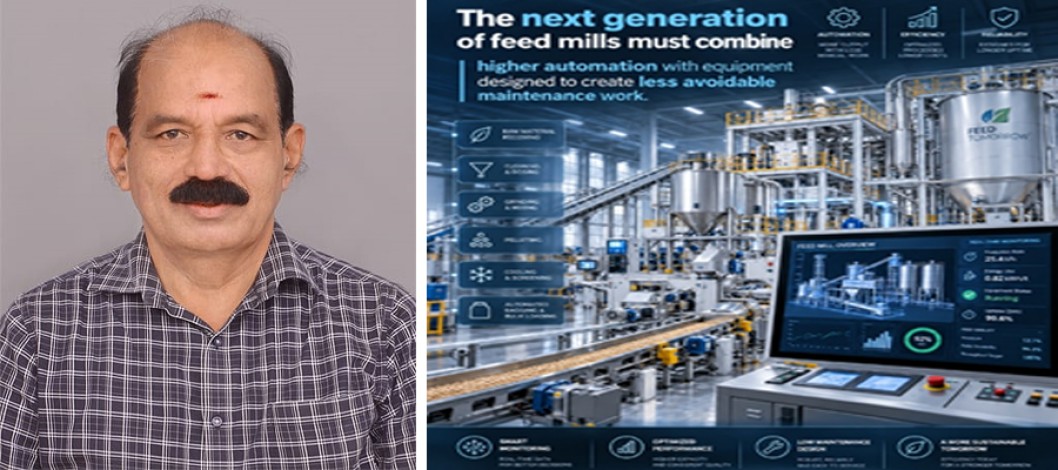
Feed mills are becoming larger, more automated and more demanding to operate, just as experienced maintenance technicians are becoming harder to recruit and retain. The industry’s response cannot be limited to finding more people or improving maintenance schedules. It must also include a more fundamental goal: designing plants that create less avoidable maintenance work.
The conventional response has been to recruit and train more technicians, expand preventive and predictive maintenance programmes, and hold larger spare-parts inventories. These measures are valuable, but they do not address the amount of maintenance work the plant itself creates.
The future challenge is not simply managing maintenance with fewer people. It is engineering feed mills that generate less maintenance work.
Move procurement from purchase price to equipment life
A feed mill may be expected to operate for decades, while parts of its material-handling infrastructure require major repair or replacement much earlier. Hammers, screens, pellet dies and press rolls are recognised wear components; recurring failure of conveyor troughs, elevator casings, hopper sheets and similar structural process components deserves closer engineering scrutiny.
This is not an argument that every component should last as long as a silo. Different equipment experiences different stresses and wear mechanisms. It is an argument for distinguishing unavoidable wear from avoidable deterioration caused by poor geometry, unsuitable materials, contamination or operating conditions.
For lifecycle comparisons to be credible, suppliers and plant owners need shared operating definitions. Component-life records should identify the material handled, throughput, operating hours, contamination level, duty cycle, maintenance history and reason for replacement. Without that context, service-life claims from different plants or suppliers cannot be compared reliably.
Maintenance begins at raw-material intake
One of the most overlooked causes of feed-mill maintenance is the condition of incoming raw materials. Maize, soybean meal and other ingredients may carry dust, sand, stones, metal and foreign matter through conveyors, elevators, grinders, bins, hoppers and downstream machinery. Maintenance teams may repeatedly replace damaged components while the original cause remains at the receiving station.
Effective pre-cleaning, aspiration, screening, magnetic separation and foreign-material removal are therefore part of equipment-life engineering. Every kilogram of abrasive or foreign material removed before processing can reduce downstream wear, contamination risk and maintenance exposure. Cleaning is not merely a raw-material quality operation; it is a plant-wide reliability strategy.
Design out recurring wear
Design-out maintenance begins by treating recurring damage as evidence, not as an isolated repair job. Where wear repeatedly appears at the same point, engineers should examine material velocity, impact angle, turbulence, chute geometry, abrasive contamination and material selection before replacing the failed section. Repair restores production; redesign prevents recurrence.
Attention should focus on predictable wear zones in elevator boots and casings, conveyor troughs and discharges, bins and hoppers, chutes and transfer points, aspiration ducts, bearings, belts, chains and rotating equipment. The objective is not to make every component excessively heavy or expensive, but to place suitable protection, replaceable liners and accessible inspection points where they create the greatest lifecycle value.
The most economical maintenance job is often the one that never becomes necessary.
Reliability depends on airflow and lubrication
Aspiration should be engineered as an integrated process function, not treated only as auxiliary dust collection. In hammer mills, inadequate or uneven airflow can delay particle evacuation, contributing to over-grinding, heat generation, reduced throughput and higher specific energy consumption. In bins, elevators and transfer points, poor venting or uncontrolled air movement can increase dust accumulation, operating difficulty, housekeeping and wear.
Lubrication deserves the same lifecycle focus. Premature bearing failure is often associated with incorrect lubricant selection, contamination, excessive or insufficient quantity, unsuitable intervals, misalignment, temperature or poor installation. Precision lubrication should reflect equipment specifications and actual operating conditions. Where appropriate, centralised or automatic systems can reduce manual intervention and improve consistency. The goal is not to become better at replacing bearings, but to prevent premature replacement from becoming routine.
Connect machine condition to process performance
Equipment deterioration does not depend on time alone. Die and hammer wear vary with formulation, material characteristics, contamination, loading and tonnes processed. Component life should therefore be evaluated through operating hours, production tonnage, measured condition, process performance and maintenance history—not calendar age alone.
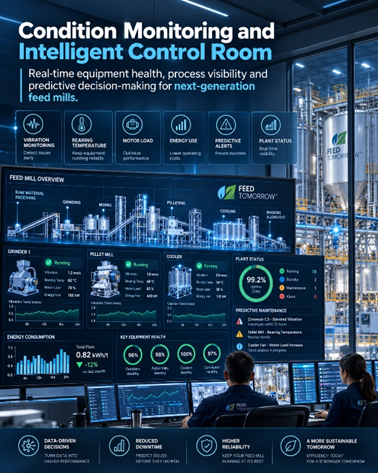
A machine can also be available while its performance is deteriorating. Worn hammers may increase energy consumption; a deteriorating die or roller may reduce throughput and pellet quality; a fan may rotate while delivering inadequate airflow. Useful indicators include vibration, temperature, motor power, throughput, specific energy consumption, airflow, differential pressure, product quality and measured wear.
Predictive maintenance can identify deterioration before failure, but it does not remove the underlying mechanism. Monitoring may warn that a misaligned bearing or poorly designed transfer point is failing again; engineering must correct the misalignment or material trajectory that causes the recurrence. Predict what cannot yet be eliminated, and design out what can.
Build a digital intelligence layer with a clear purpose
A digital intelligence layer can connect equipment specifications, operating hours, production tonnage, lubrication records, condition trends, energy use, wear measurements, failure history and spare-parts data. Its purpose is not to collect more data, but to reveal relationships between asset condition and process performance that conventional maintenance records often miss.
For example, rising hammer-mill energy consumption combined with declining throughput and a changing particle-size distribution may indicate deteriorating grinding conditions. Changes in pellet-mill energy, capacity and pellet quality may offer early evidence of die or roller deterioration. Over time, a reliable health profile for each critical asset can support condition-based intervention, remaining-life estimates and better spare-parts planning.
Artificial intelligence should not be introduced merely because it is fashionable. Establish reliable equipment, measurements and process data first; apply analytics where they improve decisions.
Redefine the technician’s role
The shortage of skilled maintenance personnel is an engineering and organisational challenge as well as a recruitment problem. If technicians spend their time repairing prematurely worn sheets, recurring bearing failures or poorly designed transfer points, the maintenance workload itself becomes part of the manpower problem.
The industry must work on two fronts: reduce unnecessary demand through better design, contamination prevention, standardisation, lubrication, monitoring and permanent failure elimination; and develop a smaller but more capable technical workforce. Future technicians will increasingly need multidisciplinary knowledge of mechanical and electrical systems, automation, sensors, data interpretation and root-cause analysis. Their role should shift from routine repair towards asset-health management and reliability improvement.
Fewer avoidable interventions can also reduce exposure to difficult repairs, elevated access and work around machinery.
Make suppliers partners in equipment life
Machinery suppliers must become partners in equipment life, not simply vendors of installed capacity. Alongside power, automation and purchase price, proposals should state expected service life under defined conditions, identify protected wear zones, explain replacement criteria, demonstrate safe maintenance access, and show how component standardisation and condition monitoring reduce lifecycle cost.
A higher initial price may be justified when evidence shows longer service life, fewer interventions and lower total operating cost. The comparison must be based on defined duty and operating conditions rather than assumptions.
Measure what the organisation permanently fixes
Maintenance cost, downtime, mean time between failures, mean time to repair, availability and spare-parts use remain valuable measures. Feed mills should add another: repeat failure rate.
Repeat failure rate should measure how often the same asset experiences the same verified failure mechanism after corrective action, expressed against a defined denominator such as failures, operating hours or tonnes processed. The definition must distinguish a true recurrence from an unrelated fault on the same machine.
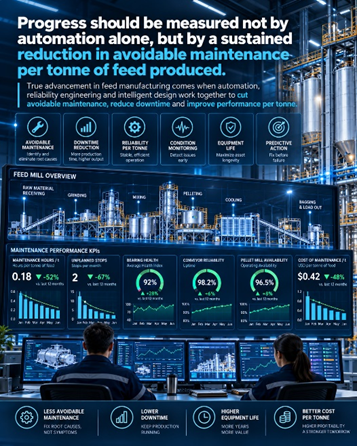
A useful dashboard can combine repeat failures, unplanned maintenance hours per 1,000 tonnes, maintenance cost per tonne, critical component life in tonnes, planned versus emergency work and verified permanent corrective actions. The management principle is simple: one recurring failure, one permanent solution wherever technically and economically feasible.
Start with five repeat failures
A practical starting point is to identify the plant’s five most frequent repeat failures, quantify their cost and production impact, verify the underlying mechanisms, and assign one permanent corrective-action project to each. At the same time, review incoming-material cleaning, lubrication standards, critical wear measurements and supplier lifecycle data. This creates a manageable first programme without waiting for a complete digital transformation.
Zero maintenance by design
Zero Maintenance by Design is not a promise that feed mills will require no inspection, lubrication or replacement of wear parts. It is a design objective: eliminate avoidable interventions, extend component life and prevent recurring failures wherever technically and economically practical.
Zero Breakdown by Intelligence is likewise an aspiration, not a guarantee. It means using engineering knowledge, condition monitoring, process analytics and predictive intelligence to manage deterioration before it creates avoidable interruption.
Together, these principles require collaboration among plant owners, machinery suppliers, project engineers, production managers, maintenance teams and automation specialists.
The next feed mill must be designed for the workforce we will have
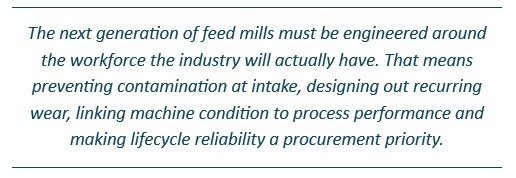
The next feed mill must be designed for the workforce the industry will actually have. Cleaner raw materials engineered wear protection, effective aspiration, precision lubrication, standardised components and intelligent condition monitoring must work as one reliability system. The measure of progress is not automation alone, but a sustained reduction in avoidable maintenance per tonne of feed produced.
Before asking, “Where will we find more maintenance technicians?”, the feed industry should first ask, “Why are we designing feed mills that require so much avoidable maintenance?”
About the author
V. Sivakumar is an engineering professional with Feed Tech Engineering, India. His work focuses on digital feed-mill concepts, lifecycle reliability and the development of next-generation technical skills for feed-mill operations and maintenance.
You can learn about South Asia's
largest exhibition on this topic through this link: https://feedtechbd.com/













Comment Now