




Photo: Collected
A total of 34,000 flood affected farmers in Chattogram have received seeds and seedlings free of cost for aman cultivation under the government’s efforts to help recovery of flood-hit farming sector.Seed beds have been set up on government property in two upazilas, and seedlings have also been provided to farmers from these locations. This prompt support from the government has enabled farmers to commence cultivation again. Consequently, Aman cultivation has already met its target.
Apru Marma, the Deputy Director of the Department of Agricultural Extension (DAE) in Chattogram, informed the National News Agency-BSS that 5 kg of Aman paddy seeds have been supplied to 33,696 farmers across 13 upazilas in Chattogram. Additionally, 399 farmers have received Aman seedlings, which were cultivated by creating seed beds on government land.
He noted that in preparation for disasters such as floods, seed beds had already been established on government land in the Hathazari and Patiya upazilas, where seedlings were produced. Following the flood, efforts were made to distribute these seedlings to farmers.
Shamsul Alam, a farmer from Puichhari in the Banshkhali upazila, expressed concern about cultivating Aman after his seedbed was destroyed by the recent floodwaters. However, after receiving seeds through government assistance, he was able to recreate the seedbed and plant the seedlings on schedule.
He remarked, 'Purchasing seeds used to incur additional costs. Receiving government seeds has alleviated that burden, allowing for timely planting of the seedlings.' Another farmer, Ismail Hossain, mentioned that it took some time to prepare the land after the floodwaters receded, leading to uncertainty regarding the Aman seeds.
'Once I received the seeds through government support, that issue was resolved. Now, the seedlings are being planted in the fields,' he added.
Ismail Hossain remarked, ‘After the flood devastated everything, I feared I would be unable to cultivate Aman this season. However, with the assistance of seeds, I am now planting the seedlings that were produced from them.’ Similarly, Muslim Uddin, a farmer from Sitakunda upazila, recounted his experience.
He stated that following the flood damage, it became challenging for him to procure new seeds and establish seedbeds. Fortunately, he was able to swiftly navigate this crisis thanks to government support. He is now planting Aman seedlings on his property.
He said, ‘After the flood, I faced financial difficulties. At that moment, receiving free seeds was immensely beneficial. I could resume Aman cultivation without delay.’ Shahidul Alam, another farmer from Lohagara upazila, noted that while there were some challenges due to silt and water accumulation on the land post-flood, the situation has since stabilized.
Farmers are collaborating in groups on the land. He indicated that Aman cultivation now represents the greatest hope for farmers to recover from the flood's impact. A total of 399 farmers have received seedbeds and seedlings on government land. A special initiative has been launched on government land this time to assist farmers affected by the flood. Aman seedbeds have been set up for 399 farmers on government land in the Hathazari and Patiya upazilas.
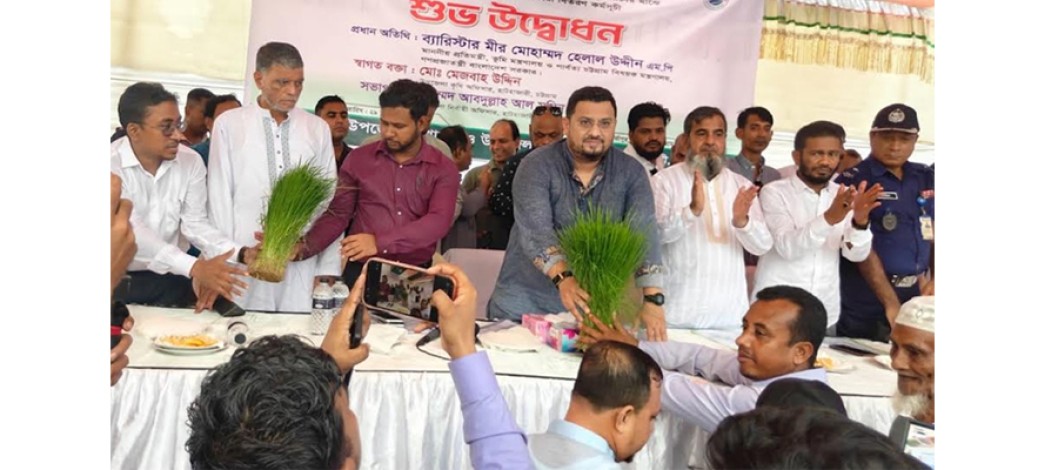
The Aman seedlings for each farmer's one bigha of land have been provided from this seedbed. The distribution of seedlings from these seedbeds is commenced on Saturday (August 29). The program was inaugurated by local MP and State Minister for Land and Chattogram Hill Tracts Affairs Barrister Mir Mohammad Helal Uddin, who distributed seedlings to farmers as part of the 'Agricultural Incentive and Rehabilitation Program' in Hathazari.
While distributing the seedlings, he said, 'The incumbent government is remains consistently accountable to the citizens as it has been elected by the people through direct voting.”
“It is and will continue to be alongside the people, providing necessary support during any disaster or calamity,” he added.
In this connection, he said the today's distribution of seedlings is a manifestation of that commitment. The primary challenge following the flood was to facilitate swift Aman cultivation, he added.
This challenge involved not only providing seed assistance to the affected farmers by the government in Mobakela but also taking initiatives to establish seedbeds on government land. As a result, a segment of farmers whose seedbeds were destroyed in the flood had the opportunity to obtain new seedlings. They will now plant these seedlings on their own land.
Farmers reported that although there were initial concerns due to the flood damage, the situation has significantly improved. They have been able to resume Aman cultivation promptly, thanks to government support and the availability of seeds in the market.
According to officials from the Agriculture Department, while the pace of Aman cultivation has slightly diminished due to this year's floods, the target will ultimately be met due to additional successes in creating seedbeds and assisting the affected farmers. This year, it is anticipated that Aman will be cultivated on a larger area than the previous year. The rate of cultivation is expected to further increase in the coming days, as Aman can be planted until the scheduled deadline of October 15.
You can learn about South Asia's largest exhibition on this
topic through this link: http://graintechbd.com/
Source: Online/GFMM























Comment Now