




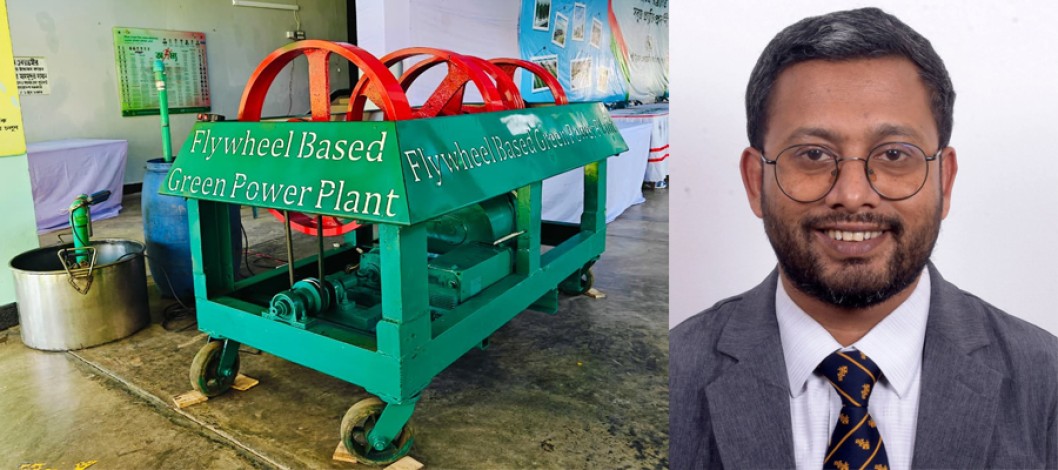
Dr. Monirul Islam: Considering the increasing demand for electricity in Bangladesh, high cost of imported fuel, load shedding and the crisis of uninterrupted power supply in industries, our innovation team at Rural Development Academy-RDA, Bogra has developed an effective prototype of flywheel-based green power technology.
This system uses a motor, variable frequency drive, gearbox, heavy flywheel, shaft, bearings and a 150 rpm permanent magnet generator. The rotational energy is stored in the flywheel through the motor and when needed, that energy is converted into electricity through the generator to handle sudden load, voltage and frequency fluctuations and short-term power shortages. In the experimental demonstration, after an initial input of 500 watts, an output of about 3 thousand watts for a short time was shown and a submersible pump was operated; The next full-scale pilot project will independently verify the total input and output kilowatt-hours, efficiency, temperature, vibration, safety and long-term stability. Flywheel technology is not limited to our laboratory; 20 MW flywheel plants in New York and Pennsylvania, USA, are being used to control the frequency of the power grid, the 30 MW Dinglun flywheel project in Shaanxi Province, China is connected to the 110 kV grid, and a large flywheel synchronous condenser in Moneypoint, Ireland is providing inertia and stability to the renewable energy grid.

According to the research team's initial comparative calculations, the cost of installing a one MW flywheel green power plant is about 250 million taka, with a target cost of 1 taka per unit of electricity, a potential lifespan of 40 years and potential savings of about 5 billion taka over the life of the project; In contrast, a solar power project of the same capacity has been estimated at 110 crore taka, 6 taka per unit, a lifespan of 25 years and a potential saving of 90 crore taka. That is, the initial cost of installing a flywheel is 85 crore taka less than solar, 5 taka less per unit and 15 years longer in lifespan. Similarly, if the comparative total cost of a one megawatt diesel-based power system is about 358 crore taka, 21 taka per unit and a lifespan of 25 years, the potential cost of a flywheel can be 333 crore taka and about 20 taka less per unit. However, solar power generates new energy from sunlight, and the flywheel mainly works for energy storage, fast supply and grid stability; therefore, these two should be seen as complementary technologies rather than competitors.
If the surplus solar power can be stored in the flywheel and supplied to evening peak demand, irrigation pumps, cold storage, hospitals, garment industry, EPZ and other industries, the use of diesel generators, fuel imports, production shutdowns and wastage of raw materials will be reduced; at the same time, the country's productivity, export capacity and energy security will increase. These calculations are still the preliminary technical and economic evaluation of the research team; however, if full pilot testing in a controlled environment, independent expert verification and domestic production of components are arranged, the flywheel technology can become an important part of Bangladesh's affordable, reliable and environmentally friendly power system.
-By Dr. Monirul Islam, Deputy Director, Rural Development Academy (RDA), Bogra. Email: monirul@rda.gov.bd.
You can learn about South Asia's
largest exhibition on this topic through this link: https://www.agromachexpo.com/























Comment Now