




Photo: Collected
In the 1980s, the journey of husking mills or small rice mills began on a commercial basis in Dinajpur, known as the rice city. Paddy used to come to these mills from various districts including Mymensingh and Netrokona. The business was also developing well. After 2000, the number of such mills increased to more than 2,500. But since 2015, the industry has gradually lost its luster.
This labor-intensive industry is now on the verge of extinction due to the shortage of labor and capital, the high demand for rice in the market, technological limitations, competition from large corporate organizations, and the strict conditions of government policies. This information was learned by talking to small rice mill owners and workers on the spot.
When visiting a husking mill in the Raniganj area of Dinajpur, it was seen that there was not much activity in it. Its entrepreneur Hafizur Rahman told, that he built this husking mill on about two acres of land around 1990. Earlier, 15 workers, both men and women, worked regularly during the rice season. The work of steaming, drying, and breaking rice was going on day and night. Now, as the labor shortage is obvious, the demand for the reddish rice they produce is also low in the market. The government is not buying rice from these mills either.
Hafizur Rahman, 65, said that on the one hand, the money from selling rice is left over, and on the other hand, he is worried about the pressure of debt and the maintenance of the mill. He has already suffered from a heart attack. He has to go to Dhaka quickly to get a ring. He regretfully told, "99 of those who used to do this have left. This will not last anymore." According to him, the labor shortage is the main reason. Even if the government had bought rice, the mills could have survived.
Hafizur Rahman's son Selim Hossain is suffering from the frustration of not being able to maintain this family business. He said that they are trying to maintain the license by renovating the Chatal and drying corn.
The same is the case with Muslem Uddin's husking mill, established in 1985. Once, 30 to 40 workers worked there. This mill in Chandganj, which was in production even two years ago, is now rented out for drying corn.
Muslem Uddin has also fallen ill. Now his son Russell Rana takes care of the mill. Russell Rana told, that adverse weather conditions have also made the work difficult. If there is no sun, paddy cannot be dried, and if it rains, work stops. If there is no work, sack-based contract workers are not available. However, the production of auto rice mills does not stop. Again, the supply of paddy to the husking mill has decreased due to the agents of the auto rice mill. Overall, the business model based on the chatal is collapsing.
The same story as Hafizur Rahman or Muslem Uddin is for almost all the husking mills in Dinajpur. In the past few days, such a picture was seen after visiting 12 mills in Dinajpur Sadar, Birol, Bochaganj and Birganj upazilas. Some have rented out rice mills as warehouses, some as chatals; some are making cow fodder from rice husks, some are making fuel from rice husks. Many of the mill workers have quit their jobs and are driving autorickshaws.
Government statistics also show the same picture. According to the district food department, 2,180 husking mills were operating in Dinajpur in 2019, which has reduced to 703 in 2025. That is, two-thirds have closed in the span of five years, and only one-third are surviving. However, many mills that were operating on paper are no longer producing. Some survive by buying rice from auto rice mills and depositing it in government warehouses, while some have rented out licenses to farmers.
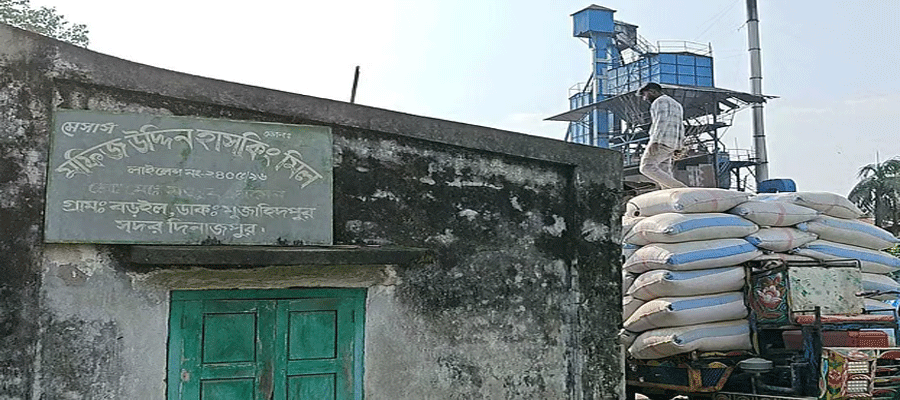 Mofiz Uddin Husking Mill in Barail village of Dinajpur Sadar has already closed down. This once busy husking mill is now trying to survive by making bran for cow feed. Photo: Collected
The twist of conditions
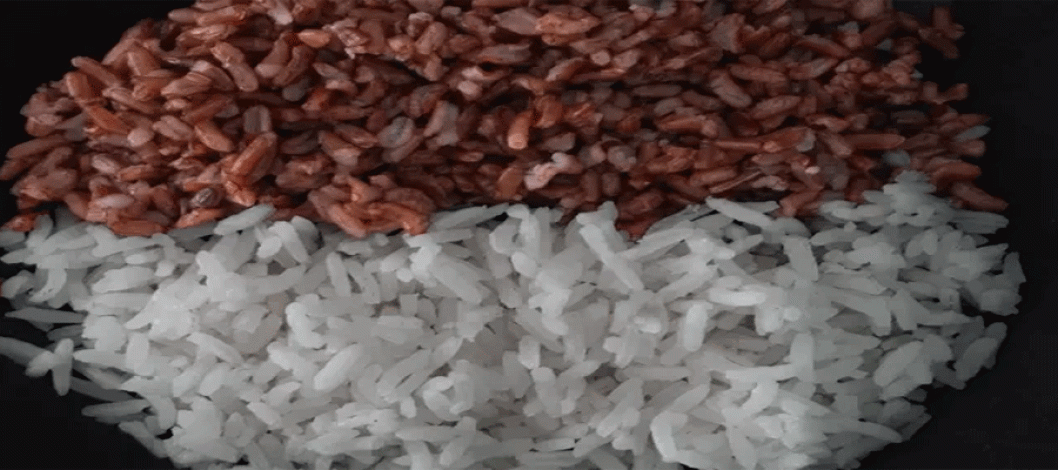
The number of modern technology auto rice mills in the country has been increasing since 2010. Big corporate companies have entered this sector with huge investments. These mills are 'steamed' to produce shiny rice. On the other hand, rice from husking mills is a bit crispy and reddish.
In 2015, the Food Ministry issued new instructions for rice procurement. At that time, Md. Kamrul Islam was the Food Minister. Raids were conducted on various mills on charges of hoarding. Since then, the crisis of small mills has been increasing.
Northern traders do not get the benefits of agricultural loans. Earlier, loans were available at 9 percent interest, but now they have to pay 14 percent interest. As a result, bank loans have to be repaid with capital. This is losing control of the market to a few companies.
According to the government policy, broken grains in rice cannot exceed 2 to 6 percent. Dead grains can be a maximum of zero.5 percent. There cannot be more than one paddy per kilogram of rice. Half-cooked grains can be a maximum of 1 percent.
Mahidul Islam, an officer of the Local Food Storage (LSD) in Dinajpur, said that they do not have any equipment to test these conditions. However, if the rice does not look shiny, it is not collected. As a result, the husking mills are out of the government's procurement. They are forced to use auto rice mills to grind or polish rice. This increases their costs and increases their losses.
Rice crisis
A husking mill has a house for boiling rice, a furnace and a rice drying shed. According to the people concerned, the Marwaris started this business before the partition (1947). Later, local entrepreneurs joined this sector.
Currently, each auto rice mill has a capacity equivalent to 20 husking mills. The capacity of the auto rice mills of some large corporate organizations is equal to 30 auto rice mills.
The supply of rice to the husking mills is also not as good as before. Talking to the people concerned, it was learned that agents are appointed to supply rice to the auto rice mills. They buy rice with advance money from the farmers. Big companies even store rice in the farmers' granaries. On the other hand, the husking mills do not have much capital.
District Food Controller Monirul Islam said that there is a kind of competition to run auto rice mills throughout the year. They can store rice up to three times their capacity. In this situation, he feels that the policy needs to be changed.
Trying to survive
Despite various adversities, some husking mills are still surviving. One such mill is Mujibur Rahman's mill at Khowar intersection in Pulhat. This 75-year-old entrepreneur has been in this business for three decades. He said that the rice produced by husking mills is soft and can be stored for up to eight months. Rice produced by auto rice mills gets attacked by insects after two months, and the rice also feels hard. That is why conscious buyers still buy rice from him. His rice is sold in various areas including Dhaka and Rajshahi.
According to millers, rice mill owners and experts, changing eating habits of people are also a major reason for the decline of the husking industry. Consumers' interest in shiny rice is increasing day by day and the demand for reddish rice has decreased. Due to this, consumers are also being deprived of nutritional value.
Professor Maruf Ahmed, Food Processing and Engineering Department, Haji Mohammad Danesh University of Science and Technology, said that reddish rice produced by husking mills is rich in nutrients and minerals. Eating overly shiny rice for a long time can reduce immunity. For this, consumers need to be made aware.
Not only husking, but auto rice mills are also facing a crisis. According to the district food department, there were 346 auto rice mills in the district in 2019. In 2025, it has reduced to 223.
Dinajpur Food Controller Monirul Islam told, that there is no survey on how many mills are needed to grind the nearly 40 million tons of paddy produced in the country. Many are unable to sustain their businesses due to the establishment of more mills than required. Many have also defaulted on their loans due to insufficient income despite building mills.
Bangladesh Auto Major and Husking Mill Owners Association Vice President Shahidur Rahman Patwari said that traders in the northern region do not get the benefits of agricultural loans. Earlier, loans were available at 9 percent interest, but now they have to pay 14 percent interest. As a result, they have to repay bank loans with capital. This is losing control of the market to a few companies.
However, some husking mill owners have not completely given up. Hafizur Rahman, a husking mill owner from Raniganj area, said that he has retained his license. He hopes that one day the demand for red rice will increase again. However, whether that good time will return or not depends largely on the awareness and choice of the consumer.
You can learn about South Asia's largest exhibition on this
topic through this link: http://graintechbd.com/
Source: Online/GFMM

















Comment Now