




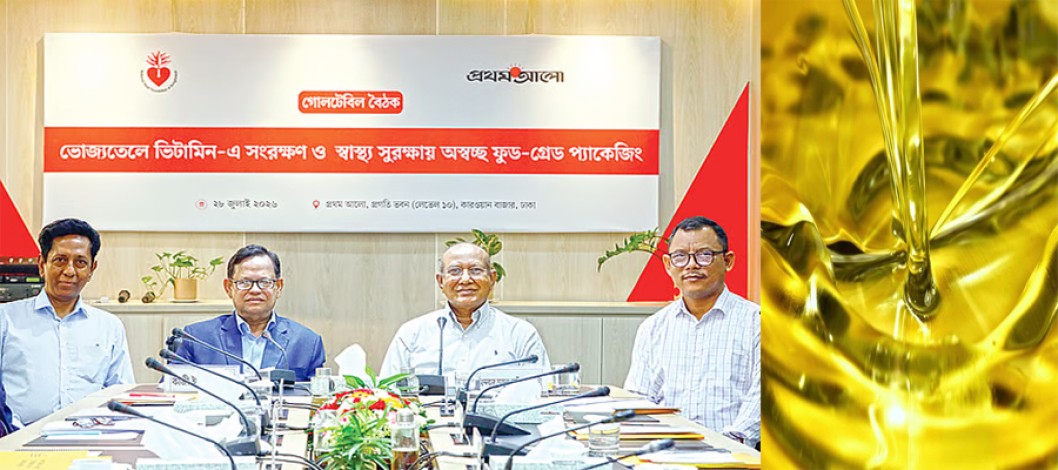
Sultan Alam, Kazi Imdadul Haque, Khandaker Abdul Awal Rizvi and Sebastian Rema at the roundtable meeting (from left). On July 29, 2026 at the Prothom Alo office in Dhaka
The roundtable titled 'Opaque Food Grade Packaging for Preservation of Vitamin A in Edible Oils and Health Protection' was organized by the National Heart Foundation and Prothom Alo
Laws and regulations say that edible oil cannot be sold open in the market. But in reality, this is not being followed. Most of the edible oil is being kept in drums made for marketing chemical products. These drums are not food-grade. As a result, various health risks including cancer are increasing among people.
In addition, transparent packaging that allows light to enter causes the nutrients in edible oil to gradually deteriorate. Therefore, the use of light-resistant opaque packaging is essential. The sale of open oil must be stopped, and the supervisory capacity of food regulatory agencies must be increased to ensure opaque and food-grade packaging.
The discussants said this at a roundtable meeting titled ‘Opaque food-grade packaging for preserving vitamin A in edible oil and protecting health’. The meeting was organized by the National Heart Foundation of Bangladesh and Prothom Alo at the Prothom Alo office in Karwan Bazar in the capital on Tuesday (July 29, 2026).
Bangladesh Standards and Testing Institution (BSTI) Director General Kazi Imdadul Haque said that the issue of food grade packaging should be presented to the public in an understandable manner. If there is a deficiency of vitamin 'A', the entire nation has to pay the price for it. From producer to consumer, it is everyone's responsibility to keep the quality of edible oil intact and unbroken.
National Consumer Rights Protection Directorate Director General (Additional Responsibilities) Sebastian Rema said that many people think why vitamin 'A' should be in the oil again. Therefore, many people do not object to the open oil in the market. Therefore, there is no alternative to making the public aware.
Industries Ministry Joint Secretary (Planning) Sultan Alam said that 'Edible oil is rich in vitamin "A"' - this issue has been successful to a large extent. However, there is scope for further work on why this oil is not safe to reach the consumer, why the oil is being sold in the open market.
The roundtable meeting was chaired by Professor Khandaker Abdul Awal Rizvi, President of the National Heart Foundation of Bangladesh. He said that even among educated people, there is a perception that clear oil in a clear bottle means it is good. To change this perception, awareness should be raised among people. He advised to eat less oil to prevent various diseases.
Mushtaq Hasan Muh. Iftikhar, founding chairman and former additional secretary of the Bangladesh Food Safety Authority, presented the keynote speech at the meeting. He said that transparent packaging cannot prevent light, vitamin 'A' is destroyed. It deteriorates the taste, smell and quality of the oil. The use of non-food grade drums mixes monomers, heavy metals, phthalates, solvents, microplastics and carcinogenic compounds in the oil. This causes cancer, hormonal problems, liver-kidney damage, as well as economic and social harm to people.
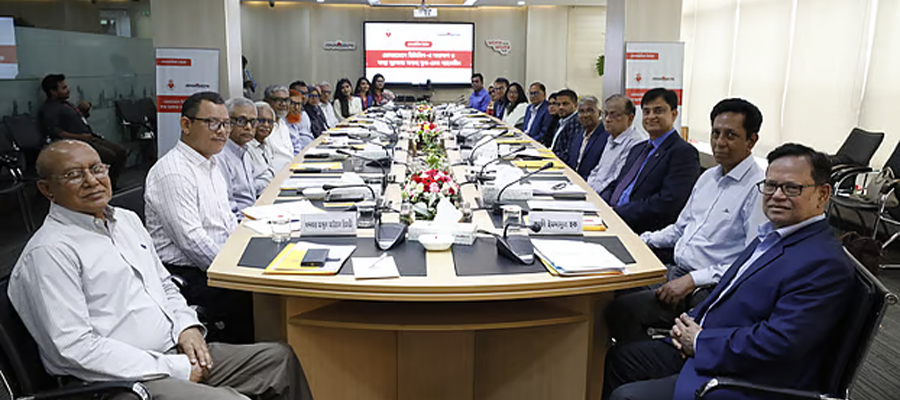 Participants in the roundtable discussion titled 'Opaque food-grade packaging for preserving vitamin A in edible oils and health protection. Photo: Collected
Bangladesh Food Safety Authority member Professor Mohammad Shoaib said that proper packaging of edible oils must be ensured. If vitamin 'A' is not found in any oil, the main culprit must be identified.
Public health expert and former chief scientific officer of IEDCR Dr. Mushtaq Hossain highlighted the health risks, including cancer, that are being created due to repeated use of the same oil. He also called for attention to be paid to ensuring that the level of vitamin 'A' in edible oils is correct and does not pose a risk to anyone.
Sohel Reza Chowdhury, professor and head of the Department of Pathology and Research at the National Heart Foundation Hospital and Research Institute, urged people to change their dietary habits, including consuming less oil, to prevent diseases. He also mentioned that it is important to add vitamin 'D' to the oil.
Firoz Alam Sumon, Joint Secretary General of the Bangladesh Restaurant Owners Association, said that just by going to Karwan Bazar, everyone will understand the real picture of the edible oil market. One oil is being sold in open drums while another oil is being sold. He believes that instead of going to restaurants, the mill owners should be fined.
Qutubul Alam, Senior General Manager of Meghna Group, said, 'We are ready to bottle or package 100% oil, we are buying equipment. But it is not possible due to lack of demand in the market.'
Professor Rokeya Begum of the Food Technology and Nutrition Science Department of Maulana Bhashani University of Science and Technology in Tangail, citing data from a survey conducted from 2019 to 2021, said that there is little awareness or understanding among people about whether oil contains vitamin 'A' or not. He believes that opaque packaging of oil is essential.
Md. Nazmus Shakib, Assistant Professor of the Nutrition and Food Engineering Department of Patuakhali Science and Technology University, said that temperature and light are big challenges in maintaining and preserving the quality of edible oil. If the open oil is removed from the market, there will be no more problems.
Gulshan Ara, Associate Scientist of the International Diarrhea Research Center Bangladesh, mentioned a study they conducted and said that the level of vitamin 'A' in packaged edible oil was found to be more than 60 percent. People in villages and cities still buy open oil because it is easily available.
Large Scale Food Fortification and Value Chain, GAIN Portfolio Lead Dr. Ashek Mahfuz suggested increasing awareness among the people to stop the sale of oil in the open market and increasing the surveillance of the relevant authorities of the government.
Shahiduzzaman Farooqui, former Director General of Food Planning and Storage Unit of FPMU, ASM Kamal Uddin, former President of Bangladesh Plastic Goods Manufacturers and Exporters, Mehedi Hasan, Food Fortification Consultant of Technoserve, KM Iqbal Hossain, Senior Vice President of Bangladesh Plastic Goods Manufacturers and Exporters Association, SM Abu Sayeed, Deputy Director (Halal Certification) of BSTI, Abul Kalam Azad, Organizing Secretary of Consumer Association of Bangladesh (CAB).
The roundtable meeting was moderated by Firoz Chowdhury, Assistant Editor of Prothom Alo.
You can learn about South Asia's largest exhibition on this topic through this link: https://oilfatbd.com/
Source: Online/GFMM


















Comment Now