



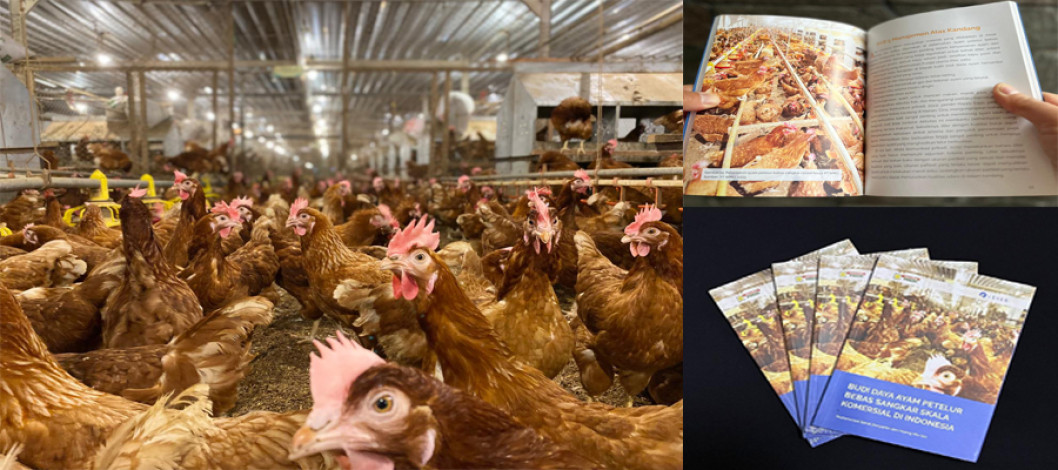
In recent years, global trends have shown increasing attention to animal welfare and food safety, particularly in layer farming systems. More than 2,300 food companies have committed to sourcing 100% cage-free eggs, including SuperIndo, Swiss-Belhotel, and Ismaya Group. Responding to this strong market demand and growing consumer awareness of food safety, the book “Commercial-Scale Cage-Free Layer Farming in Indonesia” was published on Tuesday, December 1, 2025.
Authored by Sandi Dwiyanto and Mutzu Huang of Lever Foundation, the book aims to provide efficient production methods and economic analysis to support volume-driven cage-free egg production. Its development involved a wide range of stakeholders, including the Ministry of Agriculture, academics, associations, integrated poultry companies, and farmers.
Sandi Dwiyanto noted that demand for food products that are more ethical, safe, and sustainable has continued to grow in recent years. In line with this trend, both global and domestic food companies have begun transitioning their egg supply chains to 100% cage-free. At the same time, the Ministry of Agriculture issued Regulation No. 32/2025 on Animal Welfare, the first of its kind in Indonesia at the end of 2025 to strengthen the competitiveness of the national food sector. In collaboration with Pertanian Press as the publisher, the content of the book has been fully adapted to reflect farming practices in Indonesia, ensuring relevance to local conditions while also introducing internationally recognized sustainable methods for the national poultry industry.
See Also: https://www.dpexpobd.com/
“Through this book, we aim to provide guidance that not only covers technical concepts and principles, but also field experience, economic analysis, and management practices implemented by farmers in Indonesia and other countries. We hope this book will serve as a valuable reference for the poultry sector,” said Dwiyanto. Meanwhile, Prof. Dr. Ir. Ali Agus, DAA., DEA., IPU., ASEAN Eng., Expert Staff to the Minister of Agriculture of the Republic of Indonesia for Livestock Product Downstreaming, emphasized that the book serves as an important guide amid the evolving global poultry industry, where animal welfare, food safety, and sustainability have become key issues that Indonesia cannot afford to overlook.
“A paradigm shift toward more animal welfare-friendly production systems is inevitable. In Europe, battery cage systems have been phased out. Australia, the United States, South Korea, and several ASEAN countries are moving in the same direction. Indonesia must position itself as part of this transition, not merely a follower—especially as global market demands and corporate commitments to cage-free eggs continue to strengthen each year,” he wrote in the book’s foreword.
Heri Dermawan, Chairman of the National Poultry Farmers Organization (GOPAN) and Member of Commission IV of the Indonesian House of Representatives (DPR RI), also expressed appreciation for the publication. He noted that the book could serve as a much-needed technical reference for poultry industry players in Indonesia.
“It is undeniable that changes in the global food industry are pushing us to rethink how farming practices can become more sustainable, adaptive to market demands, and still maintain national competitiveness. This book provides a comprehensive overview—from global trends and animal welfare standards to technical management and economic analysis, including case studies from farms in China and business analysis in Indonesia that can support strategic decision-making for farmers considering system transformation,” he said.
Achmad Dawami, Chairman of the Indonesian Poultry Breeding Companies Association (GPPU), who also contributed a foreword, highlighted that recent developments in the global poultry industry show increasing attention to more animal welfare-friendly layer farming systems. This international trend has not only led to new regulations in several countries but has also shaped market expectations for higher production standards.
He added that this shift presents opportunities for Indonesia’s poultry sector to access new market segments, both domestically and within global supply chains. However, these opportunities must be pursued while maintaining production efficiency and considering domestic market conditions to ensure a realistic and sustainable transition.
“I hope this book will serve as a useful reference for stakeholders in understanding these trends and opportunities, and as a foundation for developing effective strategies to navigate the evolving global landscape,” he said.
These developments are further supported by the results of a consumer survey conducted by Lever Foundation in collaboration with GMO Research in July 2025. The survey found that 72% of consumers believe that hotels, restaurants, supermarkets, and food companies should use only cage-free eggs in their supply chains. In addition, 55% of consumers stated that they are more likely to choose food brands that use 100% cage-free eggs.
The book is now available and can be accessed free of charge via the Pertanian Press website or through the following link: https://epublikasi.pertanian.go.id/pertanianpress/catalog/book/202. It is expected to serve as both a practical and strategic reference for stakeholders—particularly farmers and poultry industry players—in understanding market opportunities, navigating the transition process, and developing more sustainable and competitive production systems at both national and global levels.
Source: Email/GFMM















Comment Now